
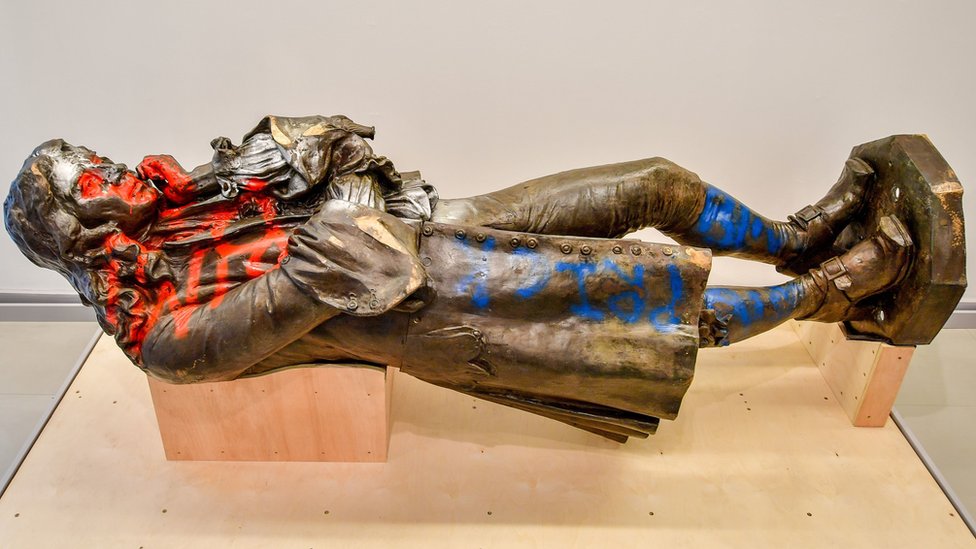
What happens when a society decides its monuments must
fall? Statues drowning in harbors, effigies beheaded in
public squares, murals defaced overnight -- these are
politically meaningful performances that reveal deep
fractures in contemporary societies.
This course explores
iconoclasm -- the deliberate destruction of culturally
significant images and objects. Though deeply rooted in the
history of religious and political conflict, iconoclasm has reemerged as one of the defining expressions of radical
politics in the 21st century. Combining ethnographic case
studies with theoretical perspectives from social
anthropology, visual studies, and political philosophy,
students will investigate how acts of symbolic destruction
function as visual manifestations of radical social change,
as dissentual practices contesting authority, and as
affective processes shaped by regimes of power. From
post-Soviet de-monumentalization to the BLM-era toppling
of colonial and racist monuments, we ask how these
seemingly disparate events share a common political
grammar, and what they tell us about political polarization,
postcolonial reckoning, and the limits of liberal democracy.
The course equips students with conceptual tools to
analyze how communities use iconoclasm to reclaim public
space, rewrite collective narratives, and demand justice.
This course draws on the research carried out within ICONS
(Icons in Crisis: Exploring Global Iconoclastic Politics in the
21st Century), funded by the European Research Council
under the Horizon Europe programme.
- Учитель: Scott Alexander
- Учитель: Nataliya Tchermalykh